AI & Business
The AI Advantage Is Not Autonomy. It Is Business Memory
The companies that use AI well may not be the ones that give agents the most freedom, but the ones that can turn scattered context, decision rules, and human judgment into usable business memory.
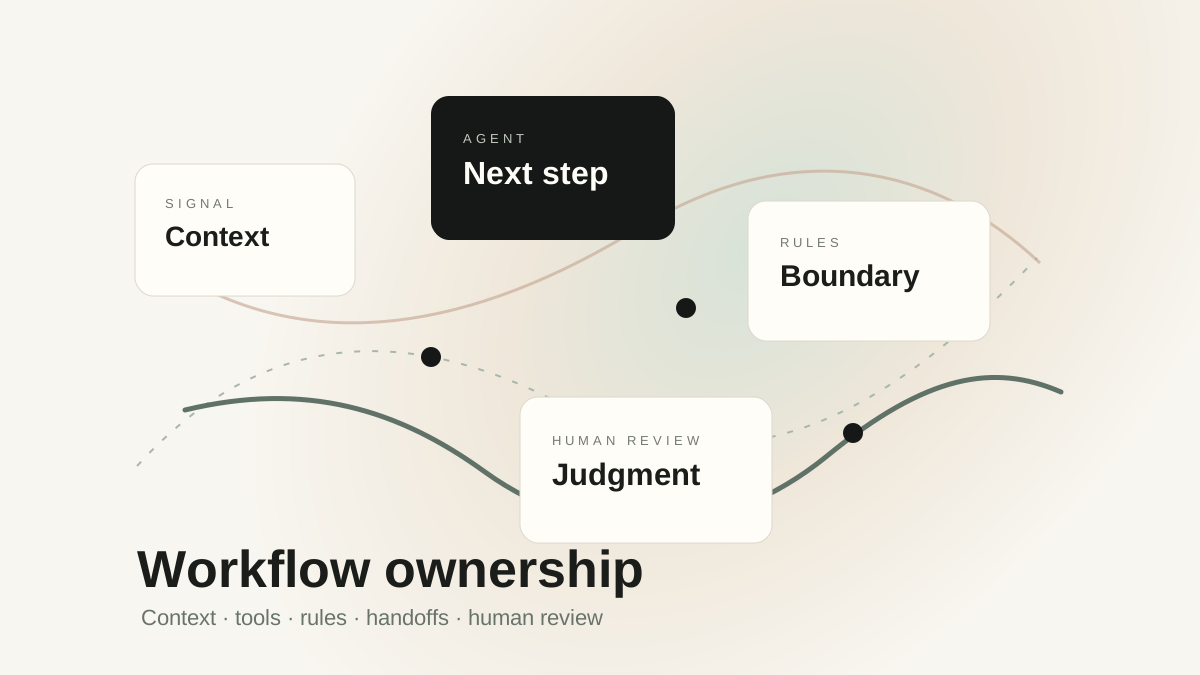
Key takeaways
- The next AI advantage may come from business memory, not louder autonomy claims.
- Business memory includes context, rules, exceptions, decisions, and judgment boundaries.
- AI projects often fail because the business has not made its decision logic visible enough.
- Permission design is a product and strategy problem, not only an engineering problem.
The least glamorous part of AI may decide whether it works inside a business.
Not the demo. Not the model name. Not the number of agents in a workflow diagram.
The harder question is: what does the business know, and can the system use that knowledge safely?
That is what I mean by business memory.
Business memory is not just data. It is the practical knowledge behind decisions: when a price movement matters, when a customer issue needs escalation, when a dashboard signal is noise, when a campaign result is worth repeating, and when speed would be dangerous.
If AI does not have access to that layer, it can still look impressive. It can summarize, draft, classify, and suggest. But it remains shallow because it does not understand how the business actually decides.
The Model Is Not The Operating System
A lot of AI conversation still begins with the visible layer.
Which model? Which agent? Which prompt? Which tool? Which automation?
Those questions matter, but they are not enough. A more useful business question is: what operating knowledge does the system need before we trust it with any part of the workflow?
In customer operations, the answer is not only conversation history. It includes policy boundaries, risk signals, tone expectations, refund rules, past exceptions, and escalation logic.
In pricing, the answer is not only competitor data. It includes margin, inventory, seasonality, category role, customer sensitivity, and timing.
In marketing, the answer is not only generated content. It includes what the audience ignored, which proof points created trust, where attention dropped, and which message should not be repeated.
The model may produce the output. Business memory decides whether the output is useful.
Why Autonomy Is The Wrong Starting Point
The word autonomy makes the conversation dramatic.
It also makes it less precise.
Most companies do not need to begin by asking how much freedom AI should have. They need to ask which decisions are structured enough, frequent enough, and valuable enough to support with AI.
There is a big difference between:
- "Let the system handle it"
- "Let the system prepare the decision"
- "Let the system notice what changed"
- "Let the system collect the context"
- "Let the system recommend a next step within known rules"
The last four are less exciting in a headline. They are also closer to how real adoption happens.
AI becomes useful when it reduces the distance between signal and decision without pretending judgment has disappeared.
Permission Is Product Strategy
The permission layer is where this becomes interesting.
What can the system see? What can it change? What should it only suggest? What must it never do without review?
Those are not only engineering questions. They are product and strategy questions.
If the system can read everything but act on nothing, it becomes a smart observer. If it can act without context, it becomes risky. If it can act within clear business boundaries, it starts becoming useful.
That boundary design is where many AI projects will either become trusted workflows or noisy experiments.
A pricing assistant that only shows competitor movement is a dashboard with better language. A stronger version says: this movement is unusual, this SKU matters, this margin band is sensitive, inventory is enough to wait, and the recommended action is to watch for another cycle before matching.
That is not magic. It is structured business memory meeting a useful model.
My Lens On This
My own interest in this comes from being between data, automation, and business decisions.
In analytics and automation work, I learned that the hardest part is often not producing the signal. It is making the signal arrive in a form that someone can trust and act on.
An anomaly alert is not valuable because it detects something. It is valuable when it helps a team understand whether the change is urgent, explainable, recurring, or worth escalating.
Price intelligence is not valuable because it collects market data. It is valuable when it helps someone separate noise from movement that actually changes a decision.
A search or discovery system is not valuable because it is technically clever. It is valuable when it reduces the customer's effort at the moment of choice.
That is why, as I move deeper into business school, I keep coming back to one question:
What does the business already know, but has not structured well enough for AI to use?
That question sits at the intersection of product, marketing, analytics, operations, and strategy.
What I Would Watch Next
I would watch three areas.
First, customer operations. The advantage will not come only from faster replies. It will come from better context, cleaner escalation, and knowing when not to automate.
Second, pricing and category decisions. Businesses already see more market movement than they can process. The useful AI layer will help distinguish noise from decisions that deserve attention.
Third, marketing learning loops. More content is easy. Better memory is harder. The winning teams will know what messages created trust, what audiences ignored, and what should change next.
Across all three, the core question is the same:
Can AI use the business's memory without weakening the business's judgment?
That balance is where the next serious work begins.
Key Takeaways
- The next AI advantage may come from business memory, not louder autonomy claims.
- Business memory includes context, rules, exceptions, decisions, and judgment boundaries.
- AI projects often fail because the business has not made its decision logic visible enough.
- Permission design is a product and strategy problem, not only an engineering problem.
- The best AI workflows will prepare better decisions, not pretend humans are no longer needed.