AI & Business
AI Strategy Has a Supply Chain Now
The next AI advantage may come from knowing which decisions deserve compute, context, latency, and autonomy - not from using larger models everywhere.
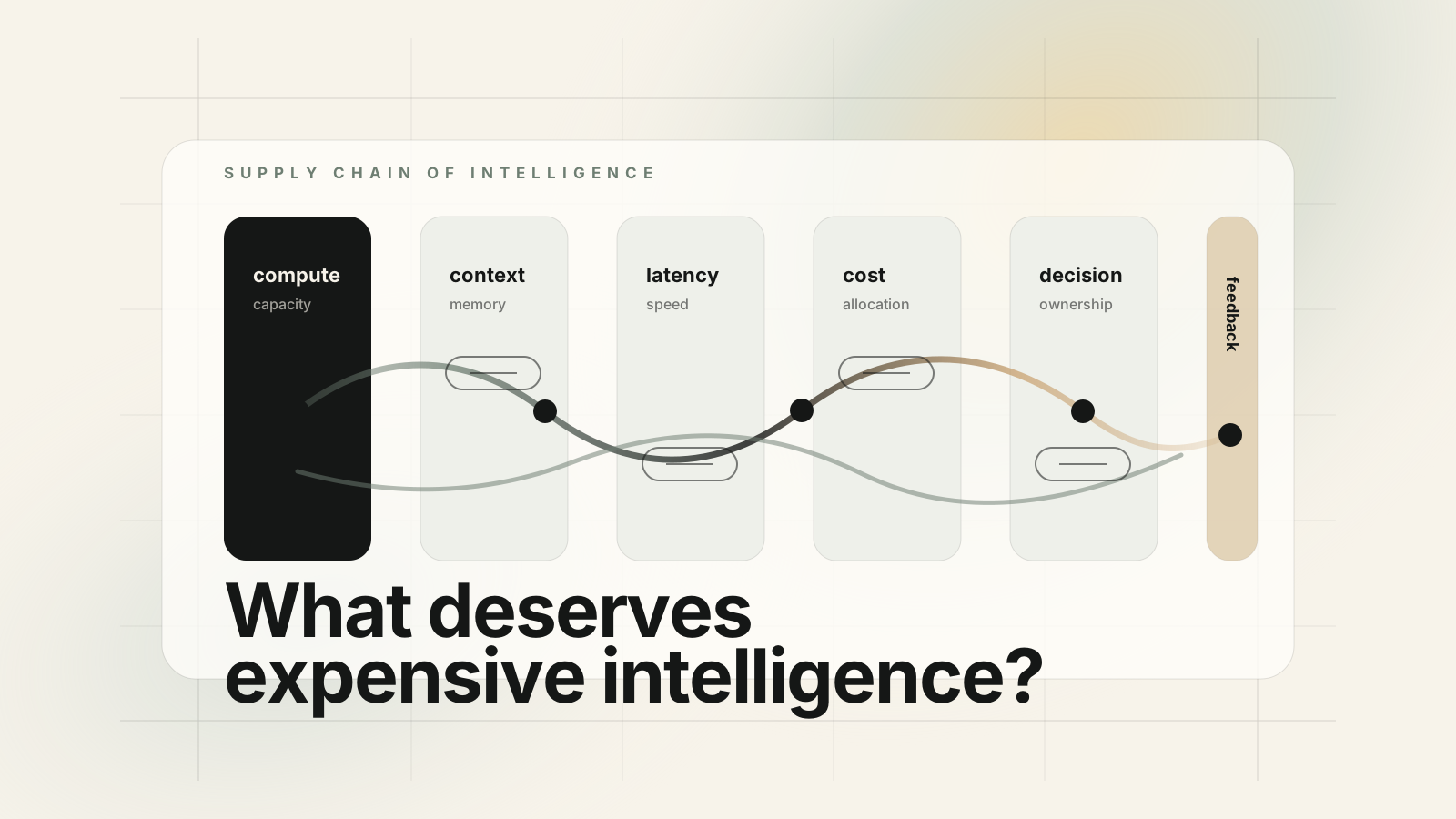
Key insight
If intelligence has a supply chain, AI strategy becomes an allocation problem: which decisions deserve which level of compute, context, speed, and human review?
Key takeaways
- AI strategy is becoming an allocation problem: compute, context, speed, cost, autonomy, and review must fit the decision.
- "Use AI everywhere" is not a strategy if intelligence has real capacity, latency, and cost constraints.
- Product teams should design for trust, fallback, uncertainty, and the right level of intelligence per user moment.
- Marketing teams need AI systems that learn from audience response, not only generate more content.
Source note: This article uses public business and infrastructure signals as context. It is a product and strategy reflection, not investment advice and not a prediction about any company.
The Boring Question AI Strategy Keeps Avoiding
Most AI strategy conversations still begin at the visible layer: the model, the tool, the prompt, the agent, the demo.
But the more useful question may be less glamorous:
What is the supply chain of intelligence?
That phrase sounds odd at first. Intelligence feels digital, instant, and weightless. But every useful AI workflow now depends on inputs that behave like operations constraints: compute capacity, energy, data access, permissions, latency, cost, reliability, context quality, human review, and feedback.
The companies building AI infrastructure understand this already. The business teams adopting AI will have to learn it next.
Compute Is Not Invisible Anymore
AI used to feel like software that happened somewhere else. A team opened a tool, wrote a prompt, and received an answer.
That illusion is fading.
When large infrastructure partnerships, dedicated AI data centers, specialized chips, energy planning, and compute-as-a-service models keep appearing in the business news, the signal is not only that AI demand is growing. The signal is that intelligence has become capacity-constrained.
This matters beyond cloud providers.
If compute, latency, and context are not free, then AI strategy cannot simply be "use AI everywhere." That is not a strategy. It is a cost leak with better branding.
The better question is: which decisions deserve expensive intelligence, and which ones need a smaller, cheaper, slower, or more human path?
The Supply Chain Of Intelligence
A normal supply chain asks: where does the product come from, what does it cost, how reliable is it, where can it break, and how should it be allocated?
AI now needs a similar map.
- Compute: How much model capacity does this workflow really need?
- Context: What data, history, and business logic must the system see?
- Permissions: Which information can the system access, and what should stay out?
- Latency: Does this decision need a response in seconds, minutes, hours, or days?
- Cost: Is the value of the decision high enough to justify the intelligence spent on it?
- Review: Where should a person approve, override, or investigate?
- Feedback: What should the system remember from the outcome?
This is not only an engineering checklist. It is a business design question.
Two workflows may both use AI, but they should not receive the same supply chain.
A customer escalation needs trusted context, policy boundaries, and fast routing. A monthly category review may need deeper analysis but can tolerate slower processing. A pricing alert may need competitor movement, margin, inventory, seasonality, and category role. A content workflow may need brand memory more than a larger model.
The intelligence should fit the decision.
The New Strategic Question: What Deserves Intelligence?
Businesses already ration scarce resources.
They ration capital. They ration attention. They ration inventory. They ration shelf space. They ration leadership time.
AI adds another resource to allocate: structured cognition.
That is why I think the next serious AI question is not "Can this workflow use AI?"
Most workflows can.
The sharper question is: should this workflow receive this much intelligence, speed, autonomy, and cost?
The answer will not be the same for every business. A high-margin enterprise product, a low-margin retail operation, a fast-moving e-commerce category, and a relationship-led service business will all draw the line differently.
Good AI strategy will probably look less like a list of tools and more like a decision portfolio.
Product Implications
For product teams, this changes the meaning of user experience.
The interface is only the surface. The real experience is shaped by how quickly the system responds, whether it uses the right context, how it explains uncertainty, when it asks for human judgment, and how confidently the user can act on the output.
A heavier model is not always a better product decision. Sometimes the better product decision is a smaller model, a stronger retrieval layer, clearer source visibility, or a more honest fallback state.
The product question becomes:
- What level of intelligence does this moment deserve?
- What would make the user trust the next step?
- What should happen when the system is uncertain?
- Which parts should be automated, and which parts should be prepared for a human?
That is a more useful product conversation than "Can we add AI to this screen?"
Marketing And Growth Implications
Marketing teams will face the same problem.
AI can generate more copy, more variants, more summaries, and more campaign ideas. But volume is not learning.
The useful supply chain for marketing intelligence includes customer memory, segment behavior, brand boundaries, channel context, previous campaign response, timing, and the reason an audience ignored something.
If that context is missing, AI makes the team faster at producing noise.
The interesting marketing question is not whether AI can create content. It can.
The question is whether the marketing system can learn which message made someone pause, which proof reduced doubt, which comparison mattered, and which promise should not be repeated.
That is where AI starts becoming a growth system instead of a content machine.
Retail And E-commerce Examples
Retail makes the supply-chain idea easier to see because every decision has trade-offs.
A product discovery workflow does not need magic. It needs to connect messy intent to the right product with minimal friction. Sometimes that means image search. Sometimes it means better filters. Sometimes it means category education.
A pricing workflow is not valuable because it sees every competitor price. It is valuable when it separates meaningful movement from noise and helps someone decide whether to watch, match, ignore, or escalate.
An operations dashboard is not useful because it has more charts. It is useful when it tells a busy team what changed, why it matters, and what should happen next.
In each case, the AI layer is not the star. The decision is the star.
The system is only valuable if it makes the decision clearer.
My Lens: MBA, Data Science, And Operating Workflows
Coming from Computer Science and Data Science into an MBA, this is the part of AI that feels most real to me.
In practical automation and analytics work, the question was rarely "Can we build something impressive?"
The question was: what decision will this help?
An anomaly alert is only useful if someone knows what action it should trigger. A price-intelligence layer is only useful if the team can interpret it with margin, timing, category role, and customer behavior. A dashboard is only useful if it reduces confusion rather than decorating it.
The MBA layer adds another lens. Strategy, marketing, operations, and consumer behavior decide where the intelligence should go. Technology can create the capability, but business judgment decides the allocation.
That is why "AI strategy has a supply chain" feels like a useful frame. It forces the conversation away from hype and toward design:
What intelligence do we need, where should it come from, how expensive should it be, how fast should it move, and who is accountable when it acts?
What I Am Watching Next
I am watching five shifts.
- AI cost will become a product design constraint, not only a finance line item.
- Smaller, specialized systems may win in workflows where speed, reliability, and context matter more than model size.
- Decision maps will become more important than tool lists.
- Human review will move from "approval at the end" to a designed part of the workflow.
- Marketing and product teams will need better memory systems, not just better generation tools.
The companies that learn this early may sound less dramatic, but they will probably build more durable systems.
Closing Takeaway
The next AI advantage may not belong to the team that automates the most.
It may belong to the team that knows where intelligence is worth spending.
That is a quieter advantage, but it is also harder to copy.
Key Takeaways
- AI strategy is becoming an allocation problem: compute, context, speed, cost, autonomy, and review must fit the decision.
- "Use AI everywhere" is not a strategy if intelligence has real capacity, latency, and cost constraints.
- Product teams should design for trust, fallback, uncertainty, and the right level of intelligence per user moment.
- Marketing teams need AI systems that learn from audience response, not only generate more content.
- The strongest business use cases will connect AI capability to a clear decision, owner, and feedback loop.