AI & Business
AI Is Becoming Business Infrastructure
AI is moving from tool adoption into the infrastructure layer of business: compute capacity, agentic workflows, decision systems, and operating models designed around data.
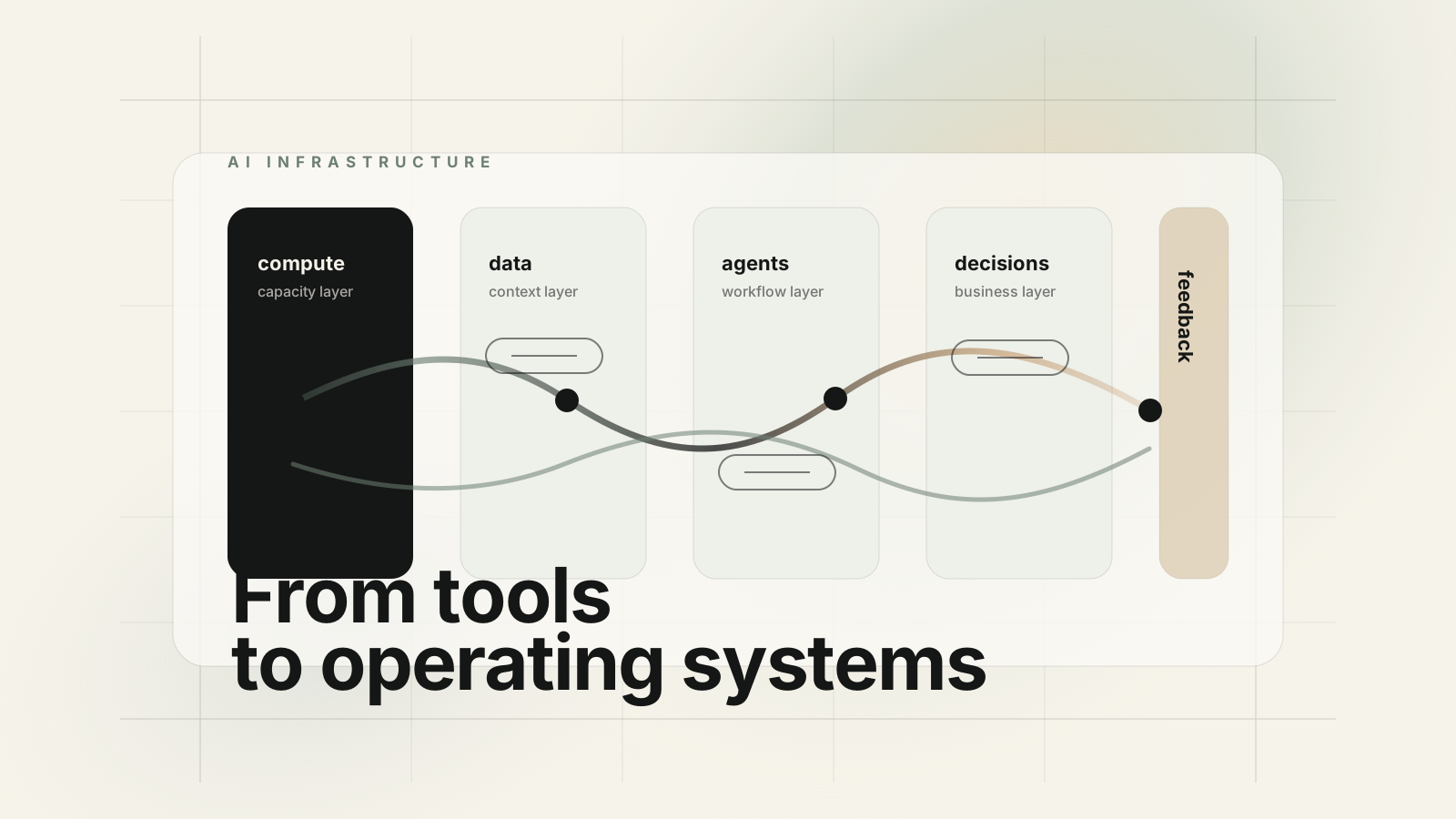
Key insight
The business question is shifting from whether a company can use AI to which parts of its operating model should become AI-native.
Key takeaways
- AI is moving from tool adoption into business infrastructure: compute, data, workflows, decisions, and governance.
- Agentic AI matters when it completes useful sequences, not when it simply produces impressive answers.
- Product, marketing, pricing, support, and operations teams should map decisions before choosing tools.
- The human role becomes more important, not less, because judgment sets boundaries for autonomy.
Source note: This article expands a short LinkedIn draft written for the first LinkedIn-to-journal workflow test on this portfolio. It is a business interpretation of public signals, not investment advice or a prediction about any specific company.
The Shift Is Not Only About Better Models
AI is starting to look less like a software category and more like business infrastructure.
For a long time, the visible question was simple: which tool should a team use? A chatbot for writing. A copilot for code. A generator for content. A summarizer for documents.
That question still matters, but it is no longer the whole story. The more important question is becoming: which parts of the operating model can be designed around AI from the beginning?
That is a different kind of question. It is not about placing an AI feature on top of the old workflow. It is about compute capacity, data access, process design, governance, customer touchpoints, and decision systems becoming connected enough for AI to change how work actually moves.
From Tool Adoption To Infrastructure
The most visible signals are physical and financial. Cloud providers, model companies, and infrastructure partners are investing in datacenters, chips, energy, networking, and AI compute capacity. These are not small app launches. They are capacity bets.
But the infrastructure story is not only about buildings, GPUs, or TPUs. That is the supply side.
Inside companies, another layer is forming: data pipelines, workflow automation, internal knowledge systems, monitoring dashboards, pricing signals, customer operations, content engines, and agentic processes. This is where AI stops being a tab someone opens and starts becoming part of the operating rhythm.
A business does not become AI-native because one team uses a model. It becomes AI-native when the work around the model changes.
Why Businesses Are Investing Beyond Apps
An app can make one task faster. Infrastructure can change the cost, speed, and quality of repeated decisions.
That difference matters.
A support chatbot may reduce response time, but the larger business question is whether customer operations can connect complaint patterns, product issues, return reasons, agent follow-up, and retention signals. A content tool may draft copy, but the larger question is whether marketing workflows can connect audience insight, campaign variants, approvals, performance learning, and brand consistency. A pricing dashboard may show movement, but the larger question is whether competitor signals, margin logic, inventory pressure, and demand behavior can be seen together.
AI becomes strategically interesting when it connects the workflow, not when it simply decorates one task.
That is why compute infrastructure and business-process infrastructure are now linked. More AI demand creates more demand for cloud capacity. But more capacity becomes business value only when companies redesign the decisions that capacity is meant to support.
What Agentic Workflows Actually Change
The word "agent" can become vague very quickly, so I prefer a practical definition.
An AI agent is useful when it can move through a workflow with context, tools, memory, rules, and supervision. It should not just produce an answer. It should help complete a sequence.
That sequence might look like:
- read the incoming request,
- retrieve the right internal context,
- check the customer, product, or order record,
- recommend the next action,
- create a draft response,
- flag unusual cases,
- update a dashboard,
- ask for human approval where risk is high.
The important shift is from task automation to workflow autonomy.
Not full autonomy everywhere. That would be careless. But partial autonomy inside well-designed boundaries can change how teams work. The human role moves from doing every repeated step to designing the workflow, checking exceptions, setting guardrails, and making the judgment calls that should not be delegated blindly.
Product, Marketing, And Strategy Implications
For product teams, AI infrastructure changes what "user experience" means. The interface is no longer only the screen. It is also the invisible system behind the screen: retrieval quality, latency, memory, permissions, fallback states, and whether the user can trust what the system is doing.
For marketing teams, the content question becomes less about producing more and more about learning faster. AI can help create variants, but the business value comes when those variants connect back to audience segments, purchase moments, brand memory, and performance signals.
For strategy teams, AI raises a harder question: where does the business actually need better decision speed? Not every workflow deserves automation. Some workflows are too sensitive, too undefined, or too strategically important to automate before the organization understands them well.
A useful AI strategy should probably start with a map of decisions:
- Which decisions are repeated often?
- Which decisions depend on scattered information?
- Which decisions are slow because the workflow crosses too many handoffs?
- Which decisions need human judgment but better preparation?
- Which decisions should never become fully automated?
That map is more useful than a list of tools.
My Lens: Data Science, MBA, And Business Workflows
My interest in this topic comes from a smaller, practical version of the same shift.
In my data science and automation work at BigHaat, the valuable part was not "using AI" as a label. The valuable part was connecting data to a business moment: automation that reduced repeated effort, anomaly signals that helped teams notice unusual patterns sooner, price intelligence that made market movement easier to read, dashboards that translated scattered data into operational clarity, and search experiences that connected customer intent to product discovery.
That experience made the MBA classroom more interesting for me. Strategy, marketing, consumer behavior, and operations are not separate from AI infrastructure. They decide where the infrastructure should matter.
A technical system can make something faster. Business judgment decides whether faster is useful, risky, wasteful, or strategically important.
What I Am Watching Next
I am watching five things.
- The shift from AI pilots to operating-model redesign. Companies will need to show not only that AI works in a demo, but that it fits into real workflows.
- The rise of decision intelligence. Dashboards may become less passive and more action-oriented, but trust and explanation will matter.
- The quality of human review loops. The best systems will know when to stop and ask for judgment.
- The connection between AI and customer experience. Faster internal workflows should eventually create clearer, calmer, more useful customer journeys.
- The economics of AI infrastructure. Compute will not be invisible. Cost, latency, reliability, and energy will shape product and business choices.
The Business Question Has Changed
The question is no longer only: can this company use AI?
Most companies can.
The sharper question is: which parts of the business should be rebuilt so AI can create better decisions, not just faster outputs?
That is where the next layer of competition may appear. Not in who has the flashiest AI feature, but in who has the clearest workflow, the cleanest data, the strongest feedback loops, and the best judgment about where autonomy belongs.
Key Takeaways
- AI is moving from tool adoption into business infrastructure: compute, data, workflows, decisions, and governance.
- Agentic AI matters when it completes useful sequences, not when it simply produces impressive answers.
- Product, marketing, pricing, support, and operations teams should map decisions before choosing tools.
- The human role becomes more important, not less, because judgment sets boundaries for autonomy.
- The strongest AI-native businesses will connect infrastructure capacity with operating-model clarity.