Data Science Applied to Decisions
The Employee Everyone Trusts May Be the Metric Companies Forgot to Measure
The most trusted employee in a company can be more than a top performer. They can reveal capability concentration, hidden operational debt, and the places where judgment has not yet become a system.
Key insight
Star performers become strategic risk when the organization depends on their memory, relationships, and judgment instead of converting that capability into repeatable systems.
Key takeaways
- Star performers can hide system weaknesses when they repeatedly compensate for unclear workflows.
- Capability concentration is an operating model risk, not just a people-management issue.
- Dashboards may miss dependency risk because they measure outcomes more easily than fragility.
- The best dependency metrics measure escalation concentration, decision latency, knowledge redundancy, handoff rework, and relationship-dependent resolution.
The most dangerous employee in a company is not always the one who underperforms.
Sometimes, it is the one everyone trusts too much.
Not because they are the problem.
Because they are the signal.
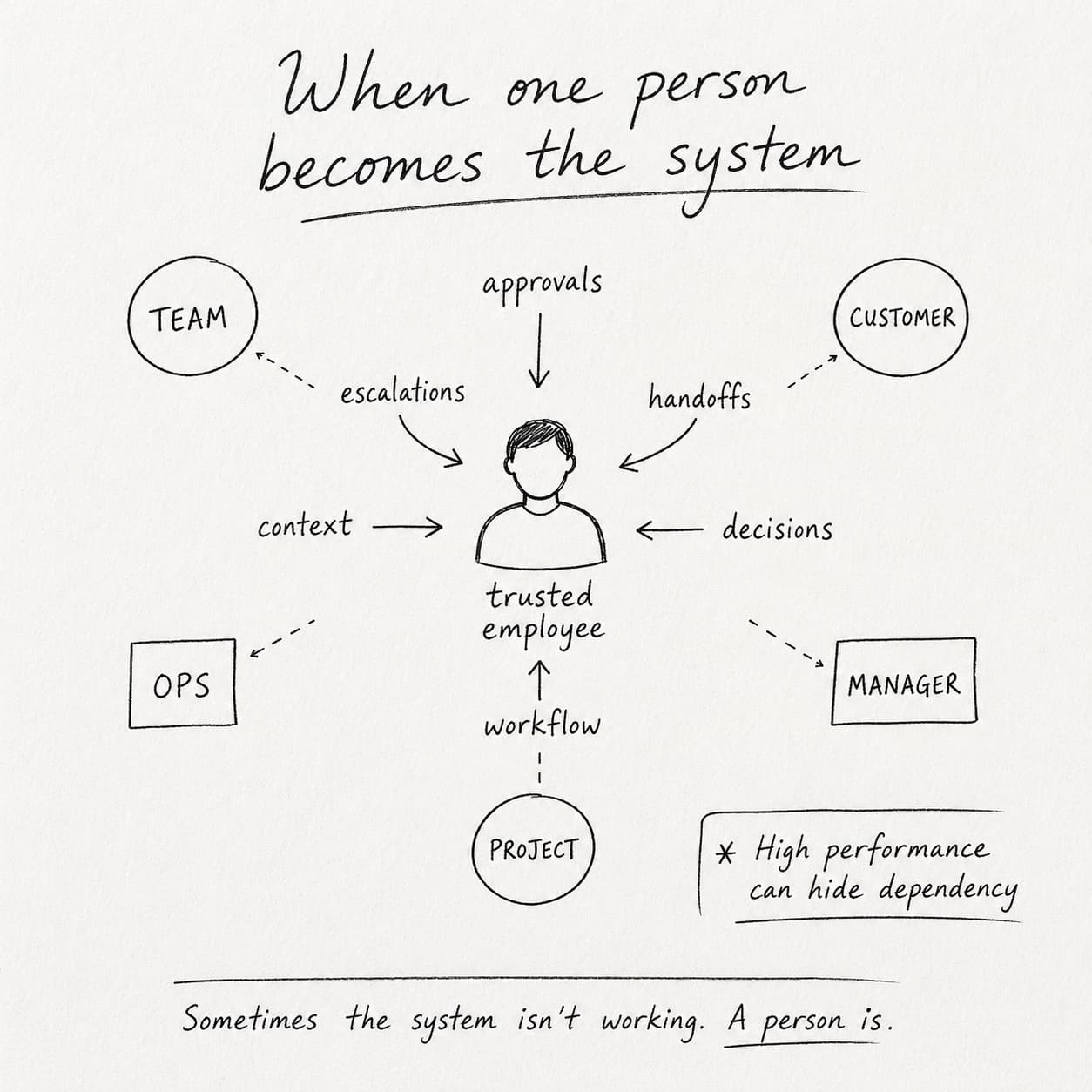
Every organization has that person: the one who knows whom to call, which approval is real, which customer issue is about to become visible, and which handoff needs context that the workflow never captured.
On the surface, this looks like high performance.
From a business analytics lens, it can also be capability concentration.
That distinction matters because many companies confuse motion with process. Work gets done, so the system is assumed to be working. But sometimes, the system is not working. A person is.
The Person Who Knows The Real Workflow
Every company has two operating models.
The first is the official one: reporting lines, dashboards, approval flows, escalation matrices, SOPs, project plans, review meetings, and ownership charts. It is the version that looks clean in a strategy deck.
The second is the lived one.
The lived operating model is where work actually moves. It is made of judgment, relationships, context, shortcuts, habits, exceptions, and quiet interventions that rarely show up in a process map.
The trusted employee usually lives inside this second system.
They know which approval requires a formal note and which one needs a quick conversation. They know which customer complaint is harmless and which one signals a bigger account risk. They know which team needs more context than the ticket contains. They know when the SLA is green but the relationship is red.
These people are often valuable. They create speed. They reduce noise. They stop small issues from becoming expensive issues.
But the stronger MBA question is not only:
"Who is performing well?"
It is:
"Why does the organization need this person this much?"
Capability Concentration
Capability concentration happens when a critical organizational capability exists inside a person more than inside the system.
The company is not only depending on their effort. It is depending on their memory, relationships, judgment, shortcuts, historical context, political awareness, and undocumented map of how work actually moves.
That can look harmless when the person is present.
Projects move. Customers are handled. Leaders get updates. Teams feel supported. The trusted employee becomes the bridge between what the process says and what the work requires.
The risk appears when the organization mistakes that bridge for infrastructure.
If one person is involved in most critical escalations, the company may not have an escalation capability. It may have an escalation person.
If approval time doubles when that person is unavailable, the company may not have a fast decision process. It may have a relationship-dependent workaround.
If only one person can explain why the same exception keeps happening, the dashboard may be reporting outcomes while missing the operating logic.
This is why top performance can become strategically ambiguous. It is both an asset and a diagnostic.
The employee is creating value.
But they may also be revealing where value creation has not yet become transferable.
The MBA Analytics Summary
If I were diagnosing this as an operating model problem, I would not start with a generic talent discussion.
I would start with dependency metrics.
The useful equation is simple:
Dependency risk = criticality x concentration x low transferability.
Criticality asks: how important is the work this person is stabilizing?
Concentration asks: how much of that work routes through them?
Transferability asks: how easily can the organization reproduce their judgment without them?
A high performer becomes an operating risk when all three move in the wrong direction.
This is where the analytics becomes more interesting than the compliment.
Escalation concentration: What percentage of critical exceptions route through one person or one informal group?
Decision latency differential: How much slower do approvals, exception handling, or handoffs become when that person is unavailable?
Knowledge redundancy ratio: How many people can explain the real workflow without asking them?
Handoff rework rate: Where does work come back because the receiving team did not get enough context?
Relationship-dependent resolution: How many exceptions are solved because someone knows whom to call rather than because the organization has a clear rule, owner, or path?
These are not HR vanity metrics.
They are operating model metrics.
They reveal whether the organization has built capability, or whether it is renting capability from one person's nervous system.
What Dashboards Usually Miss
Most dashboards measure whether work got done.
They are weaker at measuring how fragile the work was while getting done.
Revenue can look fine. Customer issues can look handled. Projects can look on track. SLAs can look green. A team can hit the number while the operating system underneath is being manually stabilized by one trusted person.
That is hidden operational debt.
Operational debt is not always a broken process. Sometimes it is a process that survives only because someone keeps paying the interest with personal judgment.
The cost does not show up immediately.
It shows up when the person is unavailable, promoted, transferred, burned out, or leaves.
Then the organization discovers that what looked like stability was dependence.
Meetings increase. Decisions slow down. Escalations become louder. Context has to be reconstructed. People start asking questions that should have been answered by the system.
Nothing changed in the market overnight.
The company simply lost the person who had been absorbing the complexity.
The Visibility, Transferability, Scalability Test
The framework I find useful has three parts: visibility, transferability, and scalability.
Visibility asks whether the organization can see dependency before it becomes a crisis.
If dependency is invisible, it will be misread as performance. "Everyone depends on them" sounds like praise until you measure how many exceptions, decisions, customer escalations, and handoffs collapse into the same person.
Transferability asks whether the person's judgment is being converted into organizational learning.
This is the heart of the issue. The goal is not to reduce the value of a strong employee. The goal is to convert part of their judgment into shared capability.
What do they notice before others do? Which decision rules do they use? What context do they add? Which exceptions do they treat as urgent? Which patterns have they learned from repeated exposure?
If that knowledge stays inside one person, the organization gets performance without learning.
If it becomes playbooks, dashboards, training loops, decision rules, clearer handoffs, and better escalation paths, the organization becomes more capable.
Scalability asks whether the workflow performs without heroic intervention.
A workflow is scalable when it does not require the same person to repeatedly rescue it. Good systems still need judgment. But judgment should improve the system over time, not permanently substitute for it.
The strongest employees should raise the operating capacity of the team.
They should not become the only reason the operating system holds together.
What Leadership Should Do With A Trusted Employee
The wrong response is to punish the person for being important.
The better response is to study how they create value.
Exceptional employees often hold the company's informal knowledge graph. They understand relationships, constraints, exceptions, and tradeoffs that the formal process has not captured.
That knowledge is strategic.
But it becomes scalable only when leaders turn it into a system.
Shadow their decisions. Map recurring exceptions. Build decision trees from their judgment. Convert repeated explanations into onboarding material. Track which handoffs they keep repairing. Identify which approval paths depend on relationships instead of rules. Pair them with others so the capability becomes distributed.
The goal is not to make the exceptional employee less exceptional.
The goal is to make the organization less fragile.
That is the difference between celebrating talent and learning from talent.
My Reflection As An MBA Student
As an MBA student with a data science and automation background, I find this idea interesting because it sits between people, process, and analytics.
In data work, we usually look for anomalies that look like problems: sudden spikes, unexpected drops, broken patterns, strange outliers.
But in organizations, some of the most important anomalies look like unusually reliable people.
That is what makes them easy to miss.
A top performer can make the system look cleaner than it is. They reduce noise before it reaches the dashboard. They solve exceptions before they become visible. They carry context the workflow never captured.
In one sense, this is admirable.
In another sense, it is a warning that the organization may not know how its own work actually gets done.
The MBA lesson for me is that performance should be studied, not just celebrated.
When someone consistently performs above the system, the question is not only how to reward them.
It is how to learn from them.
Key Takeaways
- Star performers can hide system weaknesses when they repeatedly compensate for unclear workflows.
- Capability concentration is an operating model risk, not just a people-management issue.
- Dashboards may miss dependency risk because they measure outcomes more easily than fragility.
- The best dependency metrics measure escalation concentration, decision latency, knowledge redundancy, handoff rework, and relationship-dependent resolution.
- Exceptional talent should create transferable knowledge, not permanent organizational dependence.
- Scalable organizations turn individual judgment into systems, playbooks, metrics, and repeatable decision logic.
Questions For Leaders And MBA Students
- Which employee does everyone call when work gets stuck?
- What capability would disappear if that person left tomorrow?
- Which exceptions are solved through relationships rather than defined processes?
- Where does decision latency increase when one person is unavailable?
- What part of the person's judgment can be converted into a system?
- Are top performers helping the organization learn, or helping it avoid learning?
Closing Thought
The best version of leadership is not becoming indispensable.
It is making judgment transferable.
Maybe the strongest organizations are not the ones with the most heroes.
They are the ones where heroes quietly turn their instincts into systems.
If your highest performer resigned tomorrow, would you lose a person, or would you lose a capability?